

Myth Busting, Meditation Style
Do Not Attempt to Clear Your Mind

Brain dead. A completely blank mind, free of thought, indicates a no longer functioning brain. You know - like that flat line that indicates a heart has stopped beating?
But isn’t a mind free of thoughts supposed to be the goal in meditation? Nope.
Your goal in meditation is to focus on one, small thing - like your breath - and let the rest of your thoughts go. It’s more about concentration than clearing your mind.
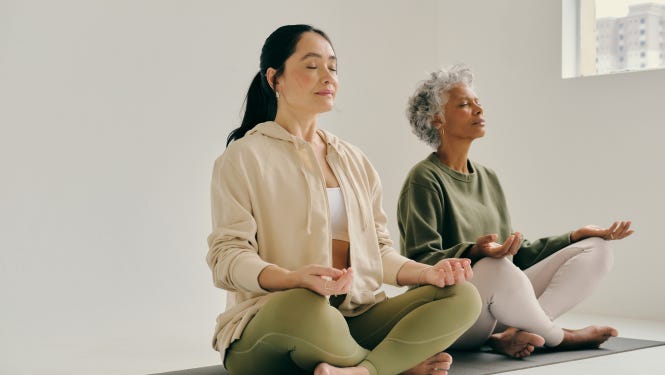
Your thoughts will still pop up, only now, when you notice them, you redirect your thoughts back to your breath. It sounds much easier than it is, and there will be times when it’s almost impossible. That’s OK. Some days are better than others. No big deal.
Why Meditate?
If meditation is hard, why try it at all? You probably have plenty of stress already without adding to it.
There are lots of things in your life that have been hard, but they haven’t stopped you. That’s probably because they were worth it in the end. Meditation can be worth it too.
Meditation gives your mind a much needed break. Think of what your head is like most of the time. Right now, I’m writing this post, thinking about making dinner, monitoring my tension, and more. We all have a million things swirling around in our heads most of the time. Meditation lets you turn it off for a while.
Another benefit of meditating is its ability to help you relax. In fact, it’s been shown to help lower blood pressure.
I have anxiety, and I spend most days feeling tense. In fact, I recently had two crowns and a filling replaced because I had cracked all of them by clenching my jaws. In my sleep! This is one of the reasons I meditate.
If you have a difficult decision to make, meditation can help by quieting your mind and clarifying your thoughts. Afterwards, you may find it easier to see the solution.
Meditation is also great for relaxing into sleep. This is another way I use it - even if I wake up during the night. Sometimes it can be hard to turn your brain off, especially at night. The room is dark, it’s quiet, and your brain has no distractions. All of those things that have been trying to get your attention all day are back, and they can keep you from falling asleep.
And here’s one of the best reasons to learn to meditate: regular meditation can deprive the stress and anxiety parts of your brain of nourishment and help heal the mind-body continuum. Your brain can become so accustomed to a calm and relaxed state that stress and anxiety don’t even affect you. Nice.
How to Meditate
Meditation needs to start with a quiet and comfortable place where you can be alone and at least 30 minutes of time. The time part is flexible, but you don’t want to rush yourself. Try to find some time when there is nothing pressing coming up so that you can fully relax.
I know that ‘alone” can be hard to do sometimes. I have simply told my husband that this is my meditation time and he respects that. The dog, however, is a mama’s girl and will not be left out. I do OK with her as long as she’s not snoring! In general, pets can be a distraction, so if you have more cooperative ones than I do, leave them somewhere else in the house.
When you are choosing a place, it’s best not to select your bed. You want to reinforce the idea that your bed is for sleeping. (This is advice from my yoga teacher, who also teaches meditation. I don’t have another place, so I meditate on my bed. And since I don’t sleep, it works fine.)
You can sit or lie down, whatever is more comfortable. And if you fall asleep, that’s actually really good. Your body needed it, and you were able to relax enough to do it. You don’t need to sit cross legged on the floor. Most of us can’t do that anymore anyway!
The basic technique is to just close your eyes and focus on your breath. Breathe in and out through your nose and pay attention to how that feels. Can you notice cooler air going in, and warmer air going out? When you notice that you are thinking thoughts and not focusing on your breathing, just go back to it.
Most people - me included - do better with a guided meditation. You can find lots of resources online. I’ve included some below. Guided meditations are just what they sound like: someone guiding you through the exercise.
Some are stories that you listen to, some ask you to visualize a setting or a relaxing activity, and some instruct you on steps like breathing. They can be very effective because they give you a concrete place to put your attention.
Tips
Meditation can be a valuable form of self-care, if you take a little time to make it yours. Here are some tips:
Try not to get discouraged. Like anything, meditation takes practice.
Any time spent meditating is worthwhile. You can increase at your own pace, or not at all.
Try a number of different meditations to find one (or more) that works for you.
Tie your meditation habit to something you already do, like brushing your teeth. This helps you build the habit faster.
If you just can’t sit still, try a walking meditation. There are recordings to assist you, and even labyrinths you can walk.
Accept that each time will be different. Some will be better than others. Work with what you have that day.
If you’re having difficulty, notice it before doing anything else. What is your body telling you? Sometimes acknowledging the sensation is enough.
Resources
Here are some apps and other places to check for meditations that work for you:
Insight Timer
Breathe
Calm
Headspace
Oak
Soothing Pod
YouTube
I’ll have to check that one out. Insight Timer is the one my teacher uses, so I tried that. It has a meditation called Walken with Walken and it’s narrated by Christopher Walken. Cracks me up.
This is wonderful, Brenda! I needed the reminder. I used to meditate often but recently got out of the habit. Time for me to pick it back up! My normal app has been Ten Percent Happier, but I think I'll check out some of your suggestions to switch things up a bit. Thanks!